Prevent Hydrogen Absorption and Embrittlement for Titanium and Its Alloys
Canadize® protects titanium alloy parts against wear, abrasion, adhesion, galling and seizing. It not only lowers the coefficient of friction (COF) of titanium substrates, it also prevents them from absorbing hydrogen and incurring its effects, such as embrittlement.
Available with a variety of dry lubricants or in combination with proprietary polymers, Canadize’s inherent lubricity reduces surface friction to allow free liquid flow while resisting contamination over a wide temperature range.
A versatile coating, Canadize can be applied to parts with various configurations, sizes and thicknesses, and our ability to precisely control the coating thickness makes it appropriate for close-tolerance parts. Ideal industries include military and aerospace, manufacturing and packaging.
Technical Advantages
Canadize exhibits superior properties compared to other common industry processes, such as titanium anodizing.
- Operating temperature range: -200°F (-129°C) to 1,200°F (649°C)
- Coating thicknesses from 0.0001 to 0.0006 inch
- Exceeds requirements of AMS 2488, Type 2
- Excellent heat transfer
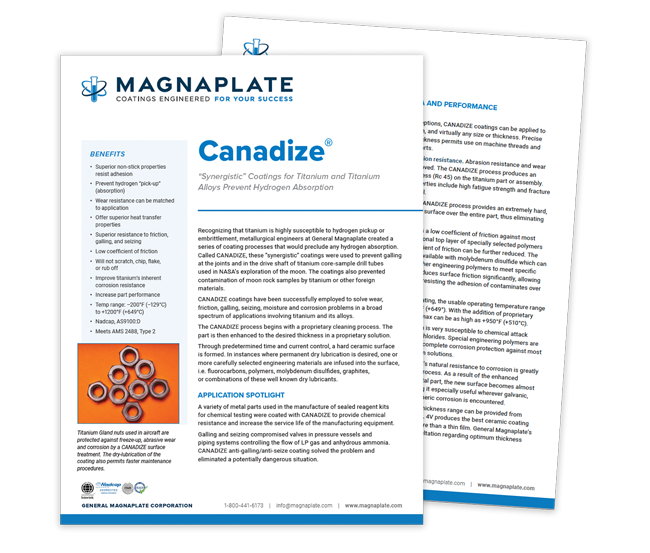 Download our Canadize brochure
Protect Titanium Parts Against Hydrogen Damage
Need to keep titanium and titanium alloy parts free from the effects of hydrogen absorption and friction? Our experts are ready to assist you.
Download our Canadize brochureRequest a QuoteRequest Assistance


©2024 General Magnaplate Corporation. All Rights Reserved.